I figured out the waste for my whips, once. It ended up being roughly 19%, which sounds like a lot, but really isn't. Waste strands can be made into cores, first bellies, falls, Turk's Heads, key fobs, and most especially Constrictor Knots. I don't shy away from waste strands at all, because there is no shortage of valid uses for them. Basically, anything that goes
inside the whip can be any color, because it will never be seen. Therefore, cores and first bellies for, say, an all-black whip could be bright purple and hunter green, and nobody would ever be the wiser.
The formula I use for my nylon whips is double the finished length of any given layer. For the overlay on a 6' whip, that's 12' per strand, and 24' for a doubled strand. It gets to be pretty simple measuring if you use the Square Start, Crown Start, Chessboard Start, etc, etc, or anything which requires you to double over a strand like that. Basically, you take the layer length and just mark out four times that length.
Paracord has elasticity too, and it can vary between manufacturers. You
will end up with waste if you use that formula, especially if you don't try to mark out individual strand lengths. I tried that only one time, and I discovered that the risk of shorting myself was too great. Like I said: The waste strands are incalculably useful for a variety of things, so I stopped caring about it.
The Constrictor Knot, if you're unfamiliar with it, is priceless to me. It can be used for a variety of tasks, such as temporary seizing of strands or bolsters, marking out drop points on the thong, or even keeping the end of a belly from unraveling while you're working on the next layer.
This video can explain the knot if you haven't tied one before:
https://www.youtube.com/watch?v=krWJaXfX4Nc
With all that said, I do love the handle pattern. The colors seem to work quite well on the thong, too, though it's too much color for my whips. Some people like 'em "loud and proud", whereas I prefer more subtle coloration. Just personal preference.

I notice that there's a large increase in diameter at the transition, and that there seems to be a very large amount of sinew building up the primary taper. Am I right in thinking that the internals are mostly made up of tapering sinew?
Some makers have successfully implemented a 4-plait first belly in their whips, which uses a very small core diameter. I'm working on a design which does this as well; I just haven't finished it yet. Most makers use an 8 plait first belly with some kind of tapering core. My handles are about 0.296" in diameter, which comfortably accepts an 8 plait with three layers of sinew, so I think that's about the outside of what you'd want to start with. The main reason for using sinew is to support the transition and provide some resistance to flexing in that area, which tapers off into full suppleness after the first couple feet.
I think your taper will be easier to control if you use that method, and you'll probably see an increase in mass and action as well. There are loads of threads on Whip Basics where several makers describe their process. I would try everything at least once, see how it works for you, and then keep all the best techniques in your next design.
One suggestion for the wire wrap: If you have a good soldering iron (not a cheapie pen from Radio Shack) and some decent solder, I'd try running the iron hot and soldering the ends of the collar shut before closing them up with knotwork. Copper transmits heat very well, so I think the tendency would be for each winding of the coil to spread that heat out rather than directly heating up the paracord underneath. You could also try some kind of heat-resistant paste underneath the coil, to protect the paracord. Basically, if you run the iron hot enough, you can bring the surface of the copper to soldering temp before the paracord heats up, then dab the solder and pull out. They use this technique in lightsaber replicas to solder Li-Ion battery packs.
I would also try coiling the copper around a dowel or pipe which is slightly smaller than the whip's diameter, then friction-fit it to the whip. The coil should ream out to the proper diameter, but still fit much more snugly.
As far as drops go, there are two methods I've seen:
-Equal Distribution: I used this myself, for almost all of my whips. You divide the finished length of the whip by the number of plaited layers you intend to use. In my case 6' / 3 plaited layers = 2' for my first belly. The second belly is 4', and so on. After that, each layer is divided by the number of strands you're dropping, plus one. 8 Plait drops 4 strands, so that's 24 / 5 =4.8" per drop. That's for single-strand drops. To get the measurement for double drops, just multiply by two.
This spaces out each drop, making the taper absolutely consistent across all layers. It was the first technique that I found that gave me what I wanted: A smooth taper. The pros are knowing when to drop, and knowing you'll have a good taper. The con is less overall mass; each layer extends into the thong at a much shorter length.
The reason for the +1 in the drop calculation is so you'll have at least one drop length worth of 4 plait at the end. This allows you to drop any core strands (or, if you're on a second belly or overlay, tail strands from the last belly) evenly before you end the belly. Basically, every plait count gets one drop length...even the 4 plait.
-Belly Extension: Don't know what else to call it. You take each belly as far out into the thong as you can, taking care to make drops evenly across each layer's length. The next belly extends just a short bit past it (6-12" is common). Drops are much more complicated to arrange, because you have to coordinate at least two drops which don't follow the measurements for the rest of the thong (8-6 and 6-4 plait drops). I'm still struggling to make that work, and may end up abandoning it.
Pros: More mass
Cons: Added complication at the end of each belly.
Congratulations on the concho, by the way, which is something I still haven't done. Your heel knot looks great, and I love the shape of it. I'm still trying to get any of my knots to come out right, and I fear it's a losing battle.
If any of us can help with any specific issues, don't hesitate to ask. It's what we're all here for.
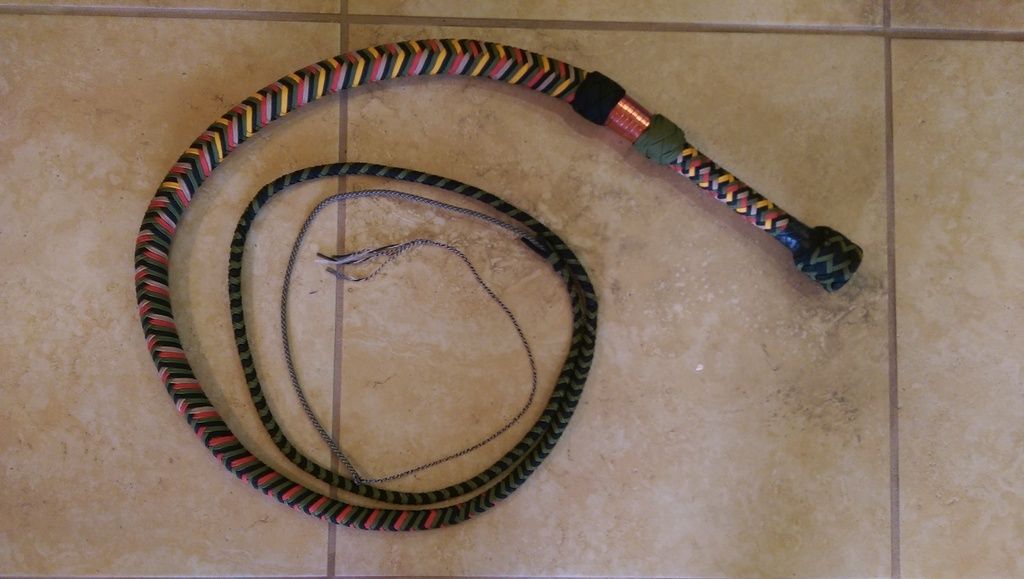


 . I think I'll try a lot of it on my next/scrap/practice whip. As for the transitions, I've been starting with the core, wrapping it in hockey tape, and then wrapping it in four telescoping lengths of sinew. Down, up, down further, up, down further, etc. I then do the same thing with the hockey tape and sinew after each belly. Also, this whip pattern called for the first belly to start just an inch above the transition so that the handle on had three layers instead of four like the thong.