





First Whip-almost finished

-
Rachel McCollough

- Member of the Ring
- Posts: 9960
- Joined: Tue 21. Apr 2015, 11:37
- Location: South Mississippi, USA
- Contact:
First Whip-almost finished
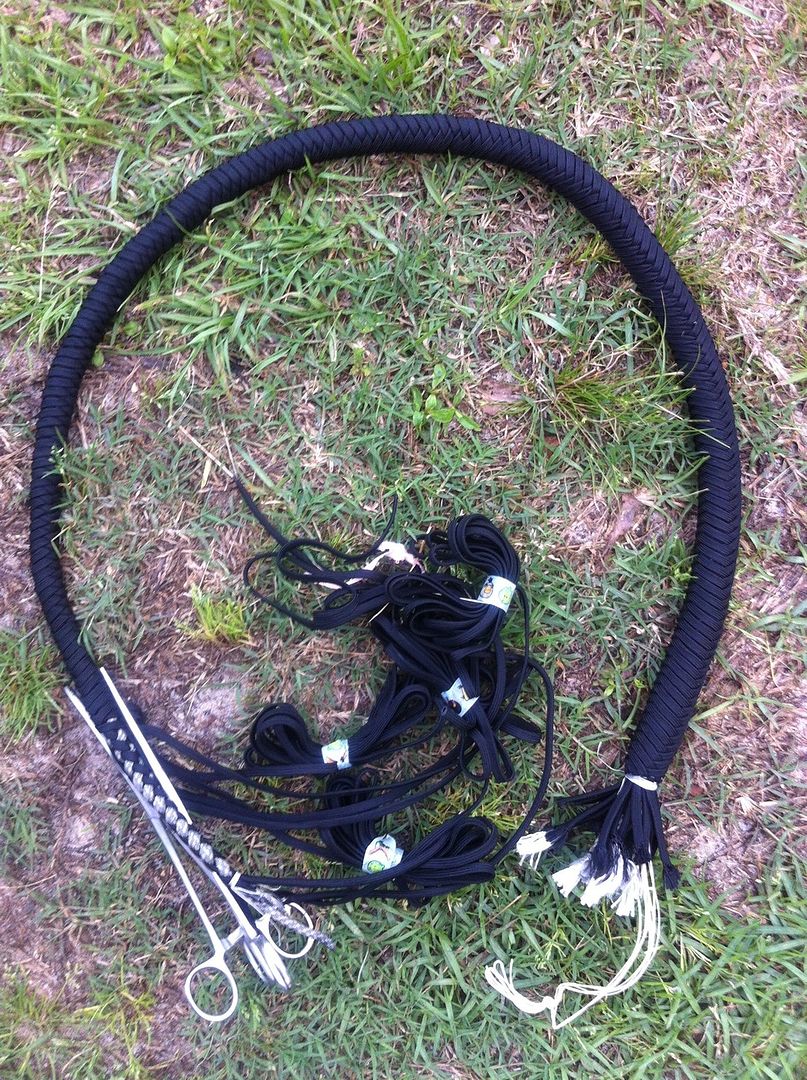
Hi All, here's what I have been working on, 4.5 ft. snake, almost finished. Bb. loaded paracord core, 8 strand belly, 12 strand overlay. Next one I hope to be much smoother without the lumps. Or not as many lumps... We will see how it cracks.
Inch by inch.
-
Ryan Fitts
-
Guest
Gotta agree with Ryan, you'll get rid of most of the bumps with some rolling. And that doesn't even look unusually bumpy anyway.
Looks like it could have used a larger plait count, and you have dropped strands a bit early. It's best if the strands are at about 45 degree angle, and dropping a little too late is better than dropping a little too early.
But all in all, that's a very nice looking first whip. You got a good taper and not much twist in the overlay. Good work!
- Pokkis
Looks like it could have used a larger plait count, and you have dropped strands a bit early. It's best if the strands are at about 45 degree angle, and dropping a little too late is better than dropping a little too early.
But all in all, that's a very nice looking first whip. You got a good taper and not much twist in the overlay. Good work!
- Pokkis
-
Rachel McCollough
- Member of the Ring
- Posts: 9960
- Joined: Tue 21. Apr 2015, 11:37
- Location: South Mississippi, USA
- Contact:
I have a full 2"x8" I used on rolling the belly on the floor is what I had available. I will definitely use a higher strand count for this diameter next one, would the angle of plait not be steep enough (less than 45degree) from pulling up away too much to tighten? I'm paranoid about covering the belly and it being tight. I did have a 16 plait on it and it looked ok, but was bunching up very soon, and I had cut some strands too short- learn! So I re did it. Thanks very much!
Inch by inch.
-
Guest
With the right plait count, covering the belly comes natural. If you feel like you have to compensate by pulling the strands upwards, the plait count is too low.
Bunching is not a bad thing really. You can always go back a bit, drop a strand and continue. But if you drop too early and start to have gaps in your plaiting, you can't go back and undrop
There are ways to figure out the best plait count for a certain thickness, but you might do yourself a favour if you don't overthink it. The 45 degree angle is just an approximation anyways and eyeballing it can be accurate enough. I have a whole bunch of notebook pages with equations for calculating optimum this and ideal that, and it took me less than a year to ditch all that. A couple of finished whips and some build notes from them is worth more than all the rocket science I tried first. Live and learn, I guess :P
- Pokkis
Bunching is not a bad thing really. You can always go back a bit, drop a strand and continue. But if you drop too early and start to have gaps in your plaiting, you can't go back and undrop
There are ways to figure out the best plait count for a certain thickness, but you might do yourself a favour if you don't overthink it. The 45 degree angle is just an approximation anyways and eyeballing it can be accurate enough. I have a whole bunch of notebook pages with equations for calculating optimum this and ideal that, and it took me less than a year to ditch all that. A couple of finished whips and some build notes from them is worth more than all the rocket science I tried first. Live and learn, I guess :P
- Pokkis
-
Rachel McCollough
- Member of the Ring
- Posts: 9960
- Joined: Tue 21. Apr 2015, 11:37
- Location: South Mississippi, USA
- Contact:
-
David Cross
It looks like this might be a double-post. Did your internet have a hiccup while posting?
I do agree about the strand count and dropping intervals. It is also important to learn twist control, which can be difficult if you're plaiting from a vise. The way I countered that was to leave a couple of feet of plait in the vise, instead of choking up all the way on where I'm currently plaiting. Every pull gives you a bit of rotation, which will actually tell you how much tension to put on the next pull. Before long, you can actually see when/if you have the right tension.
Also...the bits of white appear to be protruding from the black strands. Did you remove the inner filler strands from the paracord, or did you leave them in? Paracord lies flatter when the strands have been gutted.
One more. Is that a steel cable I see extending from the tip of the whip? I used them for a few of my earlier whips. They do give good weight, and they're great to plait around. I eventually decided to move away from them because they're not quite flexible enough for me. Still...I'm glad I used them when I did, because it gave me all kinds of useful information.
I also agree about the bumps...or lack thereof. This looks very smooth to me. The taper is good, and I don't really see any kinks at all. That's hard to get when you're starting out; trust me, I know. That you were able to get this kind of shape with a BB core is even more impressive to me. I had trouble with my taper when I tried them.
It looks good. There are a few points to work on in your next design, but I say you're already well on your way. There is nothing stopping you.
I do agree about the strand count and dropping intervals. It is also important to learn twist control, which can be difficult if you're plaiting from a vise. The way I countered that was to leave a couple of feet of plait in the vise, instead of choking up all the way on where I'm currently plaiting. Every pull gives you a bit of rotation, which will actually tell you how much tension to put on the next pull. Before long, you can actually see when/if you have the right tension.
Also...the bits of white appear to be protruding from the black strands. Did you remove the inner filler strands from the paracord, or did you leave them in? Paracord lies flatter when the strands have been gutted.
One more. Is that a steel cable I see extending from the tip of the whip? I used them for a few of my earlier whips. They do give good weight, and they're great to plait around. I eventually decided to move away from them because they're not quite flexible enough for me. Still...I'm glad I used them when I did, because it gave me all kinds of useful information.
I also agree about the bumps...or lack thereof. This looks very smooth to me. The taper is good, and I don't really see any kinks at all. That's hard to get when you're starting out; trust me, I know. That you were able to get this kind of shape with a BB core is even more impressive to me. I had trouble with my taper when I tried them.
It looks good. There are a few points to work on in your next design, but I say you're already well on your way. There is nothing stopping you.
-
Roy Partin

- C Member
- Posts: 3471
- Joined: Thu 23. Jan 2014, 16:01
- Location: Red River County, Texas
- Contact:
Not a bad first build at all Rachel. Making little mistakes here and there is the only way we can learn and get better on the next build. My first thought is I agree with David on gutting the cord. It will plait much smoother without the filler strands. Getting the correct plait count will come to you quickly with the next couple builds. You will be able to correspond the correct overlay count with the belly count. Taper is a characteristic that is near the top of the list in whip design. I have to say that your taper is excellent. Keep on building and experimenting and you will find what your looking for. Well done Mam.
He died for me, I'll live for him
-
Guest
I believe those ungutted strands you're seeing aren't used in the plaiting. There's only a couple of them after all, and the plaiting itself looks nice and flat. My guess is that they're filler strands over the core.
David, I don't think that's a steel cable. More like one of the belly strands.
- Pokkis
David, I don't think that's a steel cable. More like one of the belly strands.
- Pokkis
-
Sir Roger Tuson
Paracord is a pretty standard width (about 4mm). As Pokkis says, you can always get the calculator and calipers out each time to measure the various diameters and work out your strand counts. However, it won't be long before you start to just 'know' how many strands you need (or can get away with for pattern work) as you modify your 'production' model.
Oh, and Pokkis' advice to leave your strands longer than you think is very wise. Suffer the wasted cord for a the first few whips as there'll be less frustration (guess who's talking from experience here ). In my whip notebook, I have recorded how much waste I was left with on a few whips but to be honest, I'm getting pretty good at working out by eye how long each one should be.
Keep at it Rachel and take loads of notes, especially on the early whips as they'll be invaluable.
Oh, and Pokkis' advice to leave your strands longer than you think is very wise. Suffer the wasted cord for a the first few whips as there'll be less frustration (guess who's talking from experience here
). In my whip notebook, I have recorded how much waste I was left with on a few whips but to be honest, I'm getting pretty good at working out by eye how long each one should be. Keep at it Rachel and take loads of notes, especially on the early whips as they'll be invaluable.
-
Sir Roger Tuson
-
David Cross
The point about waste is a good one. I calculated it once, and I was surprised to see it was only 19%! Not only is that within my "acceptable losses" threshold, but you can also use the "waste" strands for knotwork. Most of my waste is never wasted.
I've got a bin full of cords that I cut from bellies and overlays. Whenever I need a length of paracord (and don't want to cut a new one), I reach for the bin. It's so convenient to have that option. It doesn't even have to be for a whip.
There are tons of paracord projects that you can pick up easily. Bracelets, for example. I'd look into those.
Anyway, the formula I use for my strands is 2x the finished length of the current layer. So, if I'm making a 6' overlay, each strand needs to be 12'. Now, that's not an absolutely accurate measurement -different lengths of whip leave different lengths of waste- but it's close enough for my purposes. I use two of the overlay strands to make my knotwork, one to make my fall, and the rest goes in the "spare cord bin".
I've got a bin full of cords that I cut from bellies and overlays. Whenever I need a length of paracord (and don't want to cut a new one), I reach for the bin. It's so convenient to have that option. It doesn't even have to be for a whip.
There are tons of paracord projects that you can pick up easily. Bracelets, for example. I'd look into those.
Anyway, the formula I use for my strands is 2x the finished length of the current layer. So, if I'm making a 6' overlay, each strand needs to be 12'. Now, that's not an absolutely accurate measurement -different lengths of whip leave different lengths of waste- but it's close enough for my purposes. I use two of the overlay strands to make my knotwork, one to make my fall, and the rest goes in the "spare cord bin".
-
Rachel McCollough
- Member of the Ring
- Posts: 9960
- Joined: Tue 21. Apr 2015, 11:37
- Location: South Mississippi, USA
- Contact:
Yes, David, my Internet hiccuped Or my phone screen was too sensitive! The pollen and dirt on my hands, phone, etc didn't help either, I'm sure.
Definitely the twist I'm very unhappy with, I had it hung at a low angle from the back of a chair but will have it up high next time. If most of that is tension control (or lack thereof) then knowing the problem is half the solution. I reckon the rest is practice- good advice from y'all, and more practice!
No cable, Pokkis is right there, it's the camo color strand that was in the belly. The core and belly contain ungutted paracord, except for the BB. filled portion, of course. I won't be braiding a belly from ungutted strands again, that's for sure- it gave that nice little kinks and twists towards the tip...
The overlay is gutted paracord. I have learned a lot if what not to do on the next one, and a whole lot of good, useful advice I greatly appreciate from y'all.
I will probably cut 2.25x length cord for my next one, just in case... My mom has a lathe (she does cabinetry) and offered to make a handle for me so that's my next planned build.
Or my phone screen was too sensitive! The pollen and dirt on my hands, phone, etc didn't help either, I'm sure. Definitely the twist I'm very unhappy with, I had it hung at a low angle from the back of a chair but will have it up high next time. If most of that is tension control (or lack thereof) then knowing the problem is half the solution. I reckon the rest is practice- good advice from y'all, and more practice!
No cable, Pokkis is right there, it's the camo color strand that was in the belly. The core and belly contain ungutted paracord, except for the BB. filled portion, of course. I won't be braiding a belly from ungutted strands again, that's for sure- it gave that nice little kinks and twists towards the tip...
The overlay is gutted paracord. I have learned a lot if what not to do on the next one, and a whole lot of good, useful advice I greatly appreciate from y'all.
I will probably cut 2.25x length cord for my next one, just in case... My mom has a lathe (she does cabinetry) and offered to make a handle for me so that's my next planned build.
Inch by inch.
-
Rachel McCollough
- Member of the Ring
- Posts: 9960
- Joined: Tue 21. Apr 2015, 11:37
- Location: South Mississippi, USA
- Contact:
@David, http://m.instructables.com/id/Poseable-Army-Men/
Another useful pattern for that extra cord waste!
Thank you very much, Roy, Bobbi, Roger, Pokkis, David and Ryan for the advice and encouragement.
Another useful pattern for that extra cord waste!
Thank you very much, Roy, Bobbi, Roger, Pokkis, David and Ryan for the advice and encouragement.
Inch by inch.
-
David Cross
Absolutely no problem at all, Rachel. We try to help out as much as possible, and one day you'll be the one giving advice. It doesn't even take that long, if you're really studying and working to improve.
When I started working on my first whip, it was with the idea that I was going to make one, and be done with it. I really only just wanted to have one. It didn't come out quite right, obviously, and there were all these questions. Once I started answering those questions, I had more questions, more ideas, more design changes...
I'm working on my 36th whip now. The design is so far from what I started with it's not funny. The reason I say all this is that, what you said above, puts you on the right track. You're already thinking about what you'll do on the next one.
And I can't wait to see it.
When I started working on my first whip, it was with the idea that I was going to make one, and be done with it. I really only just wanted to have one. It didn't come out quite right, obviously, and there were all these questions. Once I started answering those questions, I had more questions, more ideas, more design changes...
I'm working on my 36th whip now. The design is so far from what I started with it's not funny. The reason I say all this is that, what you said above, puts you on the right track. You're already thinking about what you'll do on the next one.
And I can't wait to see it.
-
Rachel McCollough
- Member of the Ring
- Posts: 9960
- Joined: Tue 21. Apr 2015, 11:37
- Location: South Mississippi, USA
- Contact:
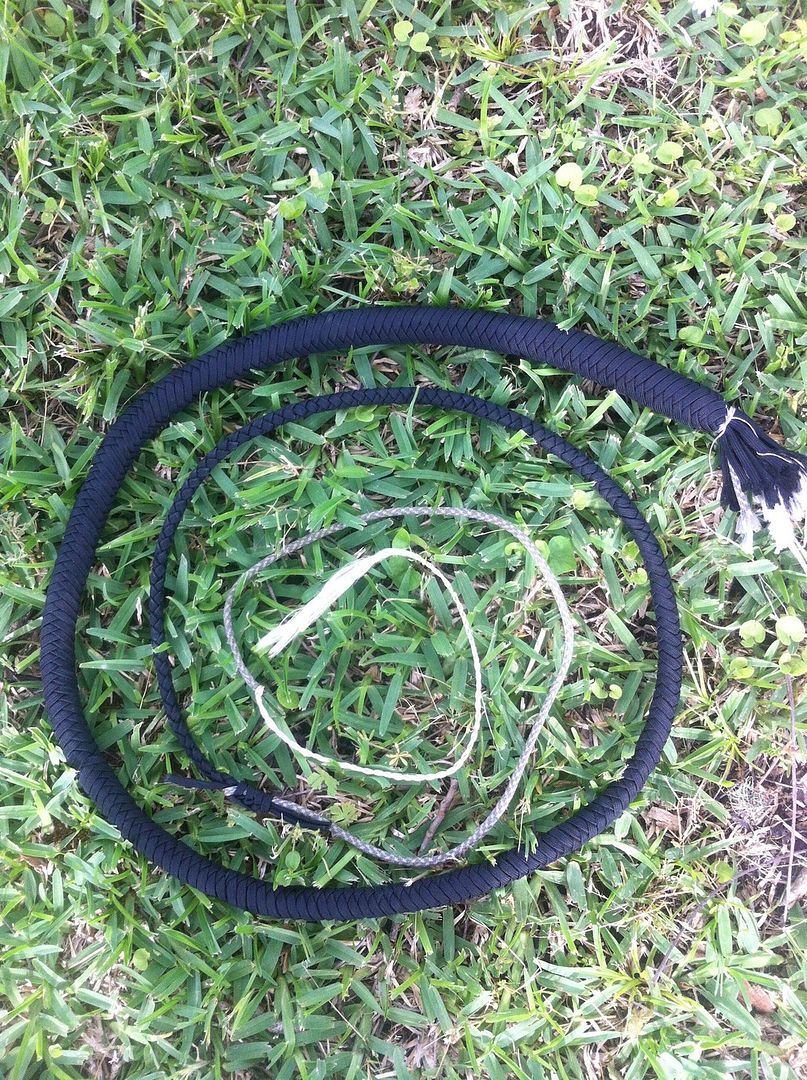
Thanks, David! I greatly look forward to each new project everyone has going, like the wax experiments etc, it seems that there is a lot of innovation happening. I thank you much! I finished plaiting and added a fall, and a very poor looking cracker... Never made either before, and of course I wanted to see if it would crack soooo... I blame that on my impatience. Still have heel knot to do and then we will see what it looks like as a finished product.

Inch by inch.
-
David Cross
-
Robert Gage

- C Member
- Posts: 14189
- Joined: Fri 7. Feb 2014, 15:58
- Location: UK